
When is an accountant not an accountant?
For business owners, cost is a factor when choosing an accountant. With individuals offering 'accounting services' at rock-bottom prices, it's easy to assume that all accountants do broadly the same job – just at different price points.
But here's the uncomfortable truth: not everyone who calls themselves an accountant is properly qualified to act as one. And for a limited company director, that distinction can make the difference between staying compliant and facing costly mistakes.
Not all accountants are created equal
Unlike some professions, the term accountant is not legally protected in the UK. This means anyone – regardless of training, experience, or qualifications – can offer accounting services to limited companies.
While some sole practitioners are highly competent, many one-man bands operate without formal qualifications, professional oversight, or adequate insurance. For a limited company director with legal and financial responsibilities, this presents a significant risk.
The legal responsibility still sits with you
As a director, you are legally responsible for your company's accounts and tax compliance – even if someone else prepares them.
This includes:
- Statutory accounts submitted to Companies House
- Corporation tax returns filed with HMRC
- Accurate treatment of dividends and director remuneration
- Compliance with accounting standards and tax legislation
If an unqualified accountant makes an error, HMRC will not pursue them — they will pursue you.
Cheap fees can hide expensive problems
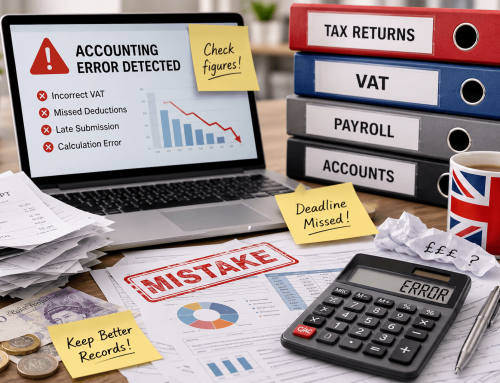
Lower fees often reflect limited expertise, minimal checks, and a "tick-box" approach to compliance. Common issues we see when directors move away from qualified accountants include:
- Dividends taken without sufficient profits
- Incorrect expense claims
- VAT errors and unsuitable VAT schemes
- Missed deadlines leading to penalties
- Accounts that don't meet statutory standards
These mistakes may go unnoticed for years, only surfacing during an HMRC enquiry or when a lender, investor, or buyer reviews the accounts. At that point, the cost of fixing the problem can far exceed any initial savings.
The importance of professional qualifications
Qualified accountants are members of recognised professional bodies such as ICAEW, ACCA, or AAT. This isn't just about letters after a name — it provides real protection for directors.
Professional accountants are required to:
- Undertake continuous professional development
- Follow strict ethical and technical standards
- Carry professional indemnity insurance
- Be subject to regulatory oversight and disciplinary action
Many unqualified accountants operate without these safeguards. If something goes wrong, your options for recourse may be extremely limited.
Mortgages, loans, and accountant references
Another area where business owners can run into difficulties is when applying for mortgages, business loans, overdraft facilities, or professional references. Banks, lenders, and mortgage providers routinely require financial information – and, in many cases, formal confirmations – to be prepared or signed off by a suitably qualified accountant.
Business owners who use unqualified accountants or informal bookkeeping services often discover too late that their figures are not accepted, or that their accountant is unable to provide the required accountant's reference. This can lead to delays, declined applications, or the need to engage a qualified accountant urgently to redo accounts at additional cost. What initially appeared to be a saving can quickly become an obstacle when financial credibility matters most.
Limited companies need more than data entry
A limited company accountant should do far more than simply prepare accounts and submit returns. Business owners should expect:
- Proactive tax planning
- Correct salary and dividend strategies
- Advice on cash flow and profitability
- Guidance as the business grows or changes
Unqualified accountants often lack the depth of knowledge needed to advise effectively – particularly when rules change or when a company becomes more complex. Poor or outdated advice can quietly cost directors thousands in unnecessary tax or compliance risk.
The risk of the 'One-Man Band'
One-man band accountants often promote a personal service, and for some directors this is appealing. However, it's important to consider the practical risks:
- No internal review or second opinion
- Limited capacity during busy periods
- No cover if the accountant is unavailable
- No access to specialist knowledge
For a limited company, reliance on a single individual without support structures can be a vulnerability rather than a benefit.
When a familiar face goes it alone
It's also worth exercising caution when an accountant you've previously worked with at a larger firm leaves to set up on their own and approaches you for business.
At first glance, this can feel like a safe choice. You already know them, you've had a good experience, and they may have an excellent reputation from their time at a well-established practice. However, a strong individual reputation does not automatically translate into the ability to deliver the same level of service independently.
When an accountant works within a larger firm, they benefit from:
- Internal technical specialists in tax, VAT, payroll, and compliance
- Regular training and updates on legislative changes
- Robust internal processes and quality controls
- Second reviews and partner sign-off on work
- Established systems for deadlines and risk management
Once they leave that environment, those safeguards often disappear.
As a sole practitioner, the same individual may now be responsible for every aspect of the service – from technical decision-making and compliance checks to administration, deadlines, and client communication. Even capable and experienced accountants can struggle to maintain the same level of rigour without the support structures they previously relied upon.
For limited company directors, this matters. The quality of your accounts may no longer be shaped solely by the individual you trust, but by the absence of the checks, balances, and specialist input that once sat behind them.
This isn't a criticism of ambition or entrepreneurship – many accountants set up successful practices. But business owners should not assume that past performance within a larger firm guarantees the same outcome when that person is operating alone, under pressure, and without oversight.
The risk, once again, sits with you.
Peace of mind is a strategic choice
Whether it's an unqualified accountant, a one-man band, or a familiar face who has gone it alone, the common thread is the same – limited companies need depth, structure, and accountability, not just good intentions.
A professional accountant is not just a cost – they are a safeguard for your business and your personal position as a director.
At Vantage Accounting, we work with limited company directors who want:
- Confidence that their accounts are compliant
- Protection from avoidable risk
- Clear, practical advice
- A long-term accounting partner, not a shortcut
When your company's finances are involved, the real question isn't 'How cheap can this be?' – it's 'How much risk am I willing to take?' Because when it comes to limited companies, an accountant isn't always an accountant.
Note: All the information and advice in this blog post was correct at the time of writing.