
Understanding VAT When Running a Business: A Complete Guide
VAT (Value Added Tax) is a crucial part of running a business in the UK, and impacts pricing, purchasing and cash flow. It's a tax collected and submitted to HMRC on goods and services. By understanding what VAT is, the rules surrounding it, the registration thresholds and available schemes, you're able to reclaim eligible VAT.
In this guide we breakdown and explore VAT for businesses, with the aim to make a complex system easier to navigate.
Key Takeaways
- VAT is a consumption tax that's applied to most goods and services in the UK.
- VAT is mandatory if your taxable turnover exceeds £90,000 (for the 2025/26 tax year depending on the goods / services provided).
- Businesses can charge VAT on sales (output VAT) and reclaim VAT on purchases into the business (input VAT).
- By choosing the correct VAT scheme you're able to improve your business' cash flow and reduce administrative burdens.
Contents
What is VAT?
VAT (Value Added Tax) is a UK tax on goods and services. It differs to income or Corporation Tax in the sense that VAT is paid by the end user but collected and processed by businesses.
Output VAT: is charged on products and services sold.
Input VAT: is paid on business purchases and is reclaimable.
How does VAT work for a Business?
For VAT-related businesses they're able to:
- Charge VAT on all taxable sales.
- Reclaim VAT on eligible purchases.
- Submit VAT returns to HMRC (this is done monthly, quarterly or annually depending on the scheme used).
Important points:
- VAT is based on your business' turnover, and not its profit.
- By monitoring sales you're able to remain compliant with HMRC and avoid penalties.
VAT Registration for Businesses
When does a Business need to register for VAT?
If your business' taxable turnover exceeds £90,000 in a rolling 12-month period within the 2025/26 tax year, you must register it for VAT. Voluntary registration is possible for businesses that:
- Work with clients who are also VAT registered.
- Want to reclaim VAT on business expenses.
- Are seeking professional credibility with their clients.
What counts as a taxable turnover?
Includes standard rate, reduced rate, and zero-rated sales. It excludes:
- VAT exempt goods and services.
- Sales that are outside of the UK's VAT scope.
Does every business need to be VAT registered?
No, as only those businesses that exceed the threshold or voluntarily register will need to collect VAT.
Paying and charging VAT
When does a business pay VAT?
- VAT returns are usually quarterly, but for some clients you may opt for monthly or annual schemes.
- Businesses pay the difference between the VAT collected and the VAT paid.
- The deadline for payment is 1 month and 7 days after the quarter ends.
The accounting methods used are:
- Accrual Accounting: VAT is recorded on the invoice date.
- Cash Accounting: The VAT is recorded on the payment received / made.
Charging VAT to customers
- Standard rate: 20%
- Reduced rate: 5%
- Zero rate: 0%
- VAT invoices must include the VAT number, rate, and whether the price is inclusive or exclusive of VAT.
Reclaiming VAT on business expenses
Eligible expenses for reclaiming VAT are as follows:
Stock, tools, software, and professional services.
Ineligible expenses include:
Client entertainment, personal use and invalid invoices.
VAT Accounting and Schemes
VAT returns and Making Tax Digital (MTD)
- Business owners must submit their VAT returns using MTD-compliant software.
- They're required to keep digital records of all sales and purchases.
- With Vantage you're able to use cloud-based software options, including xero and freeagent.
Which VAT scheme is right for you?
Standard VAT Accounting Scheme: is the default scheme.
Flat Rate Scheme: charges a fixed percentage of your business' turnover and is used by businesses with a turnover of less than £150,000 in your first year, then up to £230,000 every year thereafter.
Cash Accounting Scheme: VAT is only accounted for on payments.
Annual Accounting Scheme: Your business completed one return per year, with advanced payments throughout.
Common VAT mistakes to avoid
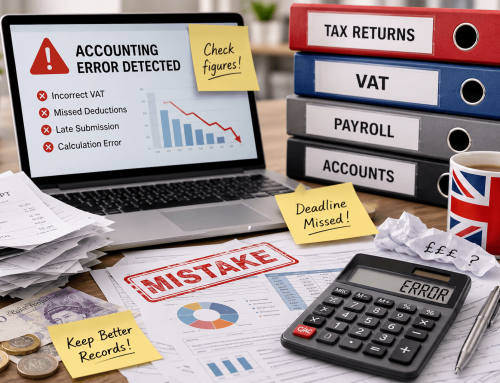
Missing registration thresholds – ensure you track your business' turnover to avoid fines.
Incorrect VAT claims – only claim for VAT on legitimate business expenses.
Motor vehicle VAT mistakes – the rules surrounding vehicles and VAT are different to those for your business. Speak to your Client Director for more information if you believe this will affect you.
Poor record keeping – ensure you remain compliant with HMRC by keeping accurate digital records.
FAQs
How Vantage can help
Here at Vantage your Client Director can help with:
- VAT registration support
- VAT return preparation and MTD compliance
- Advice on the best VAT scheme for your business
- Ongoing compliance and audit support
Final Thoughts
It's critical to understand VAT for your UK business. The correct registration, accurate digital recordkeeping, and selecting the right VAT scheme can save your business money, improve its cashflow, and ensure compliance with HMRC.
With your Client Director's expert support, VAT can become manageable, rather than overwhelming. Get in touch with them today to discuss your business' VAT.


Note: All the information and advice in this blog post was correct at the time of writing.