
Key dates throughout the financial year for Limited Company Directors, Buy-To-Let Landlords and Sole Traders
When running your business you’ll have legal responsibilities such as filing and submitting various forms and returns to Companies House and HMRC throughout the financial year. Failing to do so will result in penalties, fines and unnecessary stress. If you’re new to the world of running your own business, you may be unaware of what those deadlines are, and what’s expected of you and when.
In this blog we highlight the key dates throughout the financial year for Limited Company directors, Sole Traders and Buy-To-Let landlords will need to be aware of, in order to keep up to date with your legal responsibilities that come with being a director.
We’ve even included a handy interactive calendar to show you the key dates depending on your business type. Simply take a look towards the end of this blog, click on which business type you are, and see what your key dates are throughout the financial year.
Limited Company Directors Key Dates
The tax year 2026/27
The UK’s tax year runs from 6 April to 5 April the following year. The following dates outline some or all of the obligations you’re required to meet throughout the financial year as a Limited Company Director:
April 2026
6 April – The start of the 2026/27 tax year
19 April – Deadline for employers to submit their Final Payment Submission (FPS) and the Employer Payment Summary (EPS) for the 2025/26 tax year
22 April – Deadline for electronic PAYE payments for March 2026
May 2026
31 May – If you employ any staff, you must provide your employees with their P60s Shows the total amount you’ve been paid through your Limited Company, including the amount of tax you’ve paid in that tax year. for the 2025/26 tax year
July 2026
6 July – Deadline for employers to report employee benefits and expenses using the P11D form Summarises the value of benefits in kind given to employees and directors in a tax year. , and to submit the accompanying P11D(b)
19 July – Is the payment deadline for Class 1A National Insurance Contributions as per P11D submissions
31 July – The second payment on account You must make payments on account every year if the total amount of outstanding tax from the previous tax year exceeded £1,000. for the 2025/26 tax year is due for Self Assessment Tax Return
October 2026
5 October – Deadline to register for Self-Assessment As a director/shareholder of your Limited Company, you must submit an annual Self Assessment, detailing your personal income and allowances to HMRC. It may include employment income, dividends paid to yourself from your company, and any other sources of income such as rental or sole trader income. if you’re self-employed or have income that’s not taxed at source
January 2027
31 January – Deadline to submit your online Self-Assessment Tax Return for the 2025/26 tax year
Deadline to pay any tax owed for 2025/26
The first payment on account for the 2026/27 Self-Assessment Tax Return
April 2027
5 April – End of the 2026/27 tax year
Accounting Filing Deadlines and Confirmation Statements
Annual Accounts – Limited Companies must file their annual accounts with Companies House by the deadline, which typically is 9 months after the end of your company’s financial year. For example, if your yearend is 31 March 2026, the filing deadline is 31 December 2026.
Confirmation Statement Contains information about your company, the director/s, and any other administrative arrangements. It must also contain information about any Persons of Significant Control that are involved in your business. – Limited Companies must file a confirmation statement with Companies House once a year, which confirms your company details. The deadline is typically 12 months after the previous confirmation statement or incorporation date.
Corporation Tax You’ll need to pay Corporation Tax to HMRC if your company made a profit during the accounting period. – Limited companies typically are required to pay Corporation Tax 9 months and 1 day after the end of your company’s financial year. For example, if your year end is 31 March 2026, the payment deadline is 1 January 2027.
Limited companies must file a Corporation Tax Return (CT600) Once a year you must file a CT600 form with HMRC, which includes details of your company’s income, minus any tax allowances or business expenses. What’s left is your taxable profit, and this will be used to calculate the total amount of Corporation Tax your company is due to pay. with HMRC, this is typically once a year if the period is no more than 12 months long. For example, if your year end is 31 March 2026, the submission deadline is 31 March 2027. This would normally be filed the same time as your accounts are submitted with Companies House.
Quarterly VAT Deadlines
If you are VAT registered, you’d normally file your VAT returns If your company is VAT registered, it is most likely that you are required to submit VAT returns to HMRC every 3 months in line with the quarters selected. You must keep your VAT records digitally and use compatible Making Tax Digital software to submit your VAT returns. quarterly. Your deadlines will depend on your VAT accounting period, but will usually align with your company’s yearend. For example:
7 May 2026 – Deadline for the VAT period ending 31 March 2026
7 August 2026 – Deadline for the VAT period ending 30 June 2026
7 November 2026 – Deadline for the VAT period ending 30 September 2026
7 February 2027 – Deadline for the VAT period ending 31 December 2026
The filing deadline mirrors the payment deadline for VAT payable to HMRC.
Ongoing Monthly Deadlines
PAYE and National Insurance Employee’s NI must be paid if your salary exceeds the Primary Threshold. If you also pay yourself or any employees/directors above the Secondary Threshold your company must also pay Employer’s NI. Income Tax will be payable on behalf of employees above the personal allowance. – Full Payment Submission (FPS) and Employer Payment Summary (EPS) are due by the 19th of each month. Most companies will pay PAYE to HMRC on a quarterly basis and paid by the 22nd in the months of July, October, January and April.
CIS (Construction Industry Scheme) Returns – Due by the 19th of each month
Sole Trader key dates
Self-Assessment tax Returns
2026
April – If your self employment income exceeded £50,000 in 2024/25 you must sign up for Making Tax Digital, start keeping digital records, and be ready to submit your first quarterly income and expenses update to HMRC. Your Vantage client director can assist you with this, or you can read more about our MTD services here.
Making Tax Digital submissions are then quarterly in line with the tax year. The first quarter end is for the period to 5 July (or 30 June depending on on how you do your accounts) and is due to HMRC by 7 August 2026.
6 April – Start of new tax year
5 October – Deadline to register as self-employed if you start a new business in the previous tax year
2027
31 January – Deadline for online self-assessment tax return submissions and payment of any tax due, including the first payment on account for the current tax year
5 April – End of current tax year
Payments on account (for tax if applicable)
31 January – First payment on account due for the current tax year
31 July – Second payment on account due
VAT (if registered)
- Depending on when your VAT accounting period is, your VAT returns are usually quarterly
- Payment is usually due one month and 7 days after the end of your VAT quarter
Payroll and PAYE (if you employ staff)
- PAYE submissions must be made to HMRC monthly
- PAYE and National Insurance payments are due on the 19th of every month for postal payments, and on the 22nd of every month for online payments
Buy-To-Let Landlords key dates throughout the tax year
Self-Assessment Tax Returns (if you receive rental income)
April – If your property income exceeded £50,000 in 2024/25 you must sign up for Making Tax Digital, start keeping digital records, and be ready to submit your first quarterly income and expenses update to HMRC. Your Vantage client director can assist you with this, or you can read more about our MTD services here. Making Tax Digital submissions are then quarterly in line with the tax year. The first quarter end is for the period to 5 July (or 30 June depending on on how you do your accounts) and is due to HMRC by 7 August 2026.
6 April – Start of the new tax year
5 October – Deadline to register for self-assessment if it’s your first time declaring rental income
2027
31 January – Deadline for online self-assessment tax return submission and payment of any tax due (including the first payment on account, if applicable)
Payments on Account (for income tax on rental income, if required)
31 January – First payment on account due for the current tax year
31 July – Second payment on account due
ATED Returns
April – These will be every April and due in April for submission. They apply on any BTL purchased within a Limited Company for over £500k (or valued at £500k on 1 April 2027, 2032, 2037, etc.) If you buy a property for over £500k, you have 30 days from completion to file the first return
Capital Gains Tax (CGT) on property sales
60 days from a property’s sale – If you sell a buy-to-let property you must report it and pay any Capital Gains Tax within 60 days of the sale’s completion
Stamp Duty Land Tax (SDLT) if purchasing property
14 days from completion – If you buy a new rental property, you have to file an SDLT return and pay any tax due within 14 days of completion
Mortgage and other business considerations
- Your mortgage payment dates
- Insurance renewals (landlord insurance, building’s insurance, etc)
- Tenancy agreement renewal dates (if applicable)
Vantage Accounting’s top tips on how to stay organised
- Use accounting software – Tools like FreeAgent and Xero can help automate reminders and streamline your record-keeping
- Consult with your Vantage Client Director – Your Client Director here at Vantage is always on hand to help you keep on top of your tax and accounting responsibilities, and understand what’s required from you. Get in touch with them whenever you have a question
- Stay informed – Whilst your Vantage Client Director is here to help you run your business from a tax and accounting point of view, it’s also important that you keep up to date with HMRC’s latest guidance to ensure compliance. Follow Vantage’s LinkedIn page to see the latest news and information that affects Limited Company directors, Sole Traders and Buy To Let Landlords
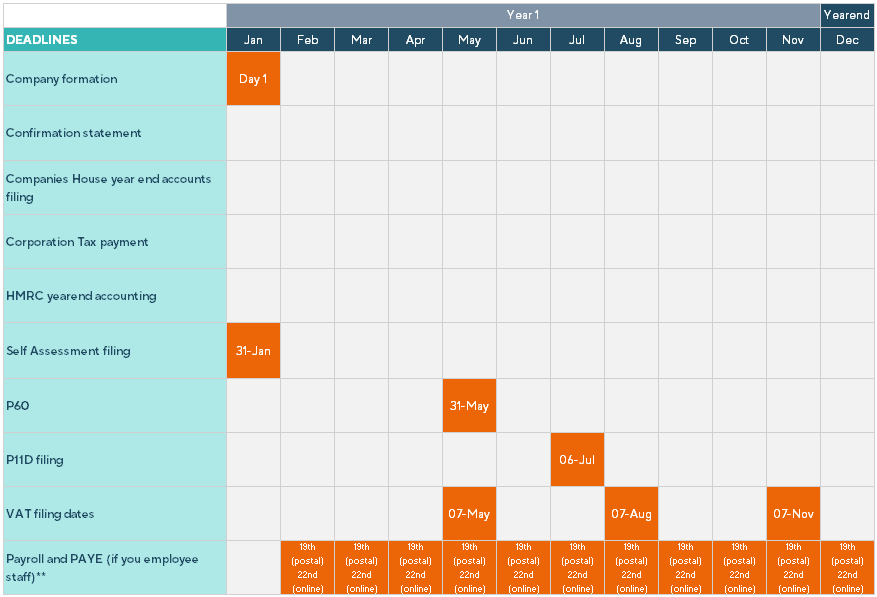
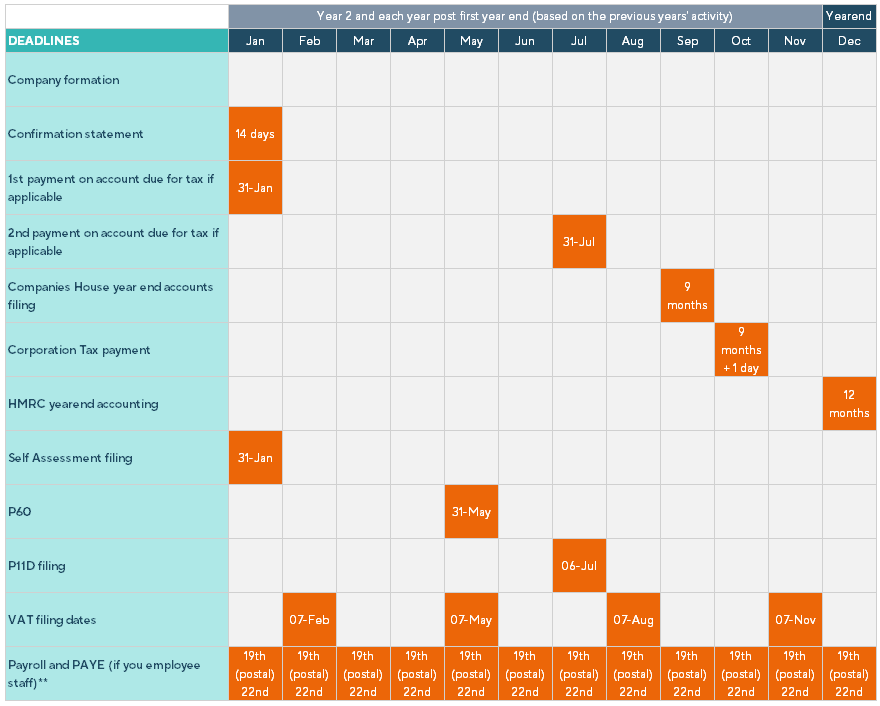 **PAYE submissions must be made to HMRC monthly.
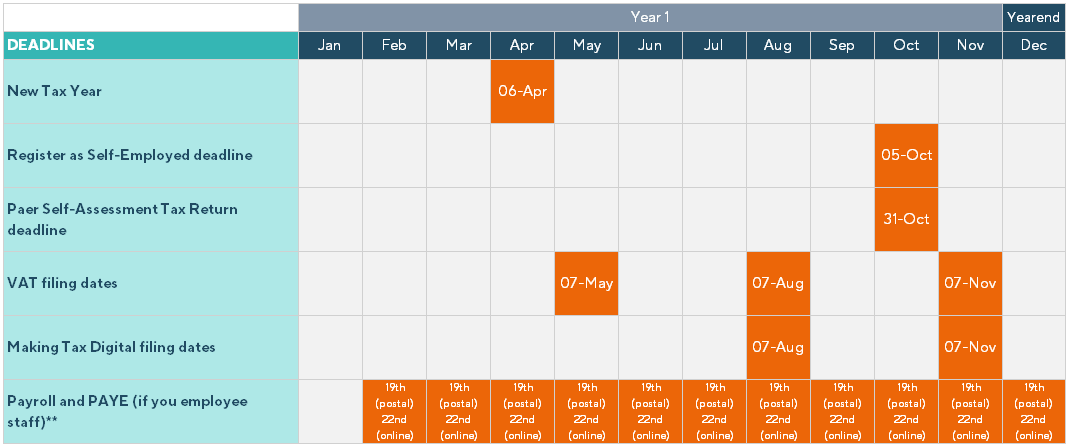
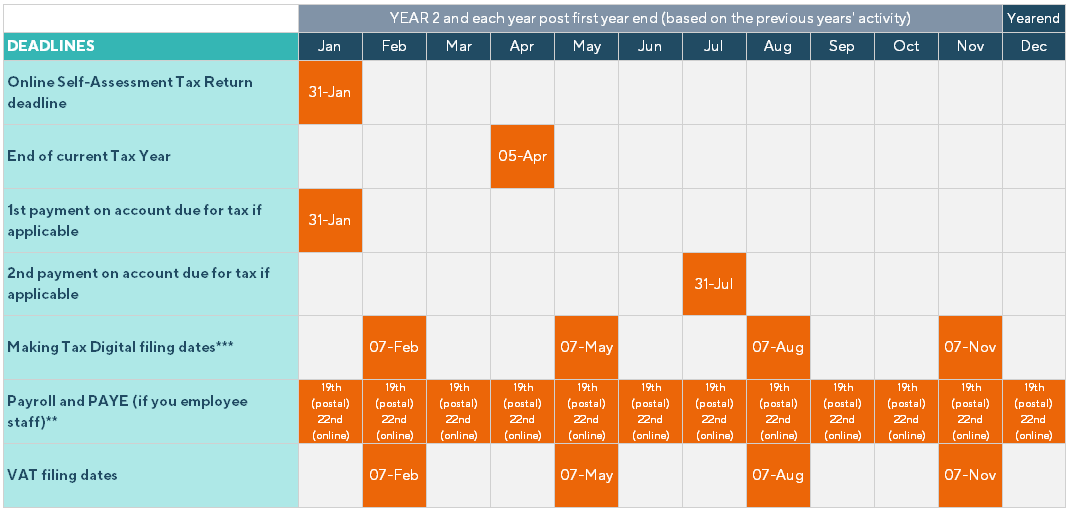
*Payment is usually due one month and 7 days after the end of your VAT quarter.
**PAYE submissions must be made to HMRC monthly.
*** Rental income + sole trader turnover – over £50,000
PAYE and National Insurance payments are due on the 19th of every month for postal payments, and on the 22nd of every month for online payments.
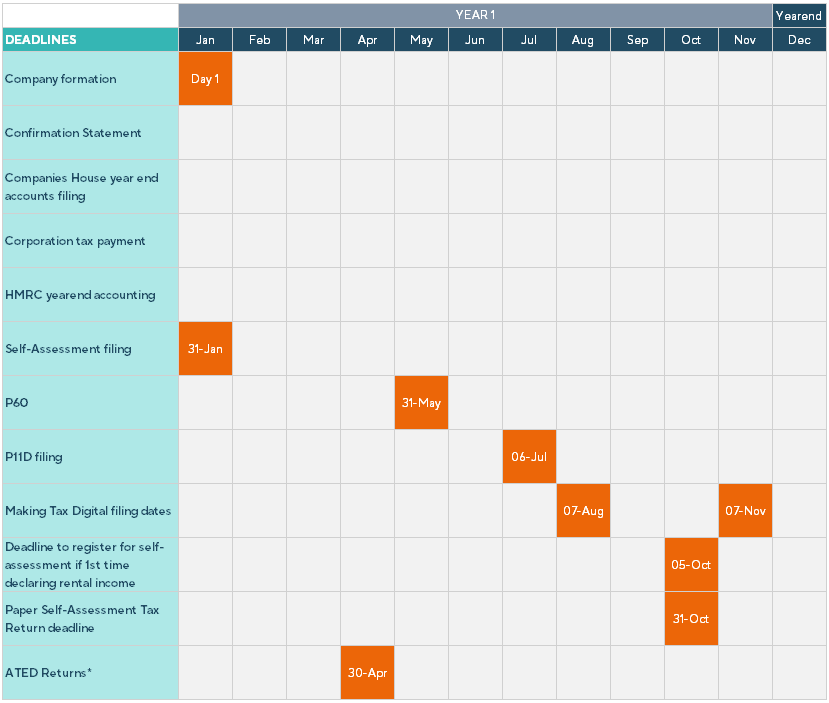
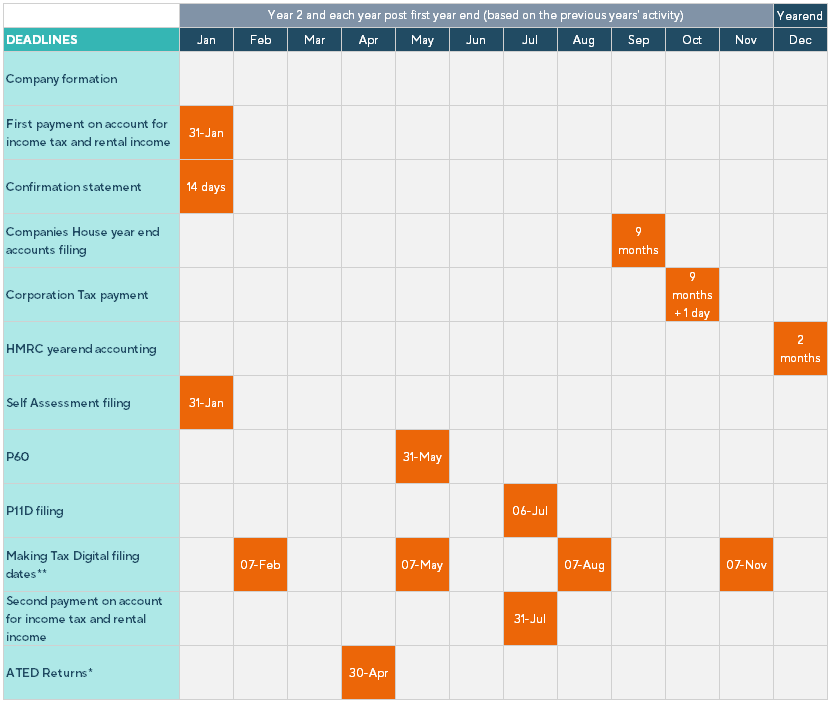
*Remember to file an ATED Return within 30 days of completing on a property where valued at over £500,000 (for properties purchased through a limited company only)
**Rental income + Sole Trader turnover – over £50,000
Vantage Accounting’s final thoughts
Staying on top of your tax obligations doesn’t need to be stressful, and by keeping these dates in mind and using the correct tools and support that’s available around you, you’ll meet your deadlines with ease and confidence. As always if you have any questions about anything to do with your company’s accounting and tax, your Vantage Client Director is always on hand to help. If you’re yet to join Vantage Accounting, get in touch today to find out more.
Note: All the information and advice in this blog post was correct at the time of writing.